content
July, the fourth invoice from the agency. The owner looks at the amount and asks his account manager what exactly that money bought.
The manager opens the report. Whether SEO is worth it stopped being a theoretical question for this company in March, when the contract for SEO services was signed. Four payments have gone out. On the screen there is a flat line that has lifted very slightly towards the right-hand edge. Technical errors fixed, fourteen pages rewritten, eight links earned. Enquiries from search across four months: one, and that was a student doing an assignment.
This is not a failure.
This is what a normal start looks like in this channel, and it is exactly what nobody mentions in March when the client signs a twelve-month agreement. The proposal listed the work, the timeline and the fee. It did not include a sentence explaining that the first four payments buy preparation rather than results, and that the July report was always going to look the way it looks.
Now the parts that never appear in a proposal at all.
You pay upfront and in full. March, April, May, June, each one the same amount. The work happens, the reports arrive, the till stays quiet. The earliest point where anything begins to move is month four, and in half of all cases month four delivers nothing either. None of that depends on how hard your supplier works, how large your budget is, or how good your website looks.
Nobody can guarantee you a position.
No agency on the planet controls the algorithm, so a promise of first place in a proposal means one of two things. Either the keyword in question is something nobody searches for, such as your full registered company name with its legal suffix. Or the sentence is simply worthless, and enforcing it would be a matter for a lawyer rather than for your analytics.
A year of work can be wiped out in a week without any input from you.
An algorithm update lands, the results page gets rebuilt, and a site that spent nine months climbing to third place in its niche wakes up on Thursday sitting twelfth. The agency is not at fault, you are not at fault, nothing can be done about it in the moment, and what follows is three or four months of recovery that you pay for month by month.
Now picture the screen you are competing for. Someone searches on a phone, and above the fold they get two paid ads, then a machine-written answer that has already summarised the question, then three businesses lifted from the map. The first organic result sits under all of that, and reaching it takes a scroll.
Your competitor started eight years ago.
Every month they did not skip has been compounding into pages, links and trust, and there is no way for you to stop that compounding. You do not buy that time back at any price, you chase it. While you chase, they are not standing still, because they are paying their own agency every month too. In practice this means the choice is not between you and an empty space, but between you and a company eight years ahead of you on every measure that decides a position.
One last detail that usually goes unmentioned. If you stop paying, what you built does not stay with you forever. It settles gradually, almost invisibly, month after month, because the competitors who did not stop keep moving past you.
That is the case against. It is stronger than most of the people selling this service will admit.
Now the second half, which is why all of the above is here. None of those points makes the answer automatically no. They make it no for one specific kind of business, and that kind is recognisable in about five minutes from a handful of signs. For everyone else the question comes down to arithmetic you can run yourself, on your own numbers, without an agency and without an article.
That is what the rest of this covers.
What it costs and what it returns
The cost side is simple and predictable. For a small or medium business in Australia it runs one thousand to three thousand dollars a month, and three to five and a half in competitive niches.
The return side is harder, because it barely depends on the agency. What you measure is not traffic but qualified enquiries, meaning calls and forms from people capable of buying. Traffic is an intermediate number that looks useful in a report and cannot be banked. The chain from money to money runs like this. Organic traffic produces enquiries, a share of enquiries become deals, each deal carries margin. Multiply margin by deals and compare it with the annual cost.
There is a point in that chain worth seeing before you sign anything.
Of those four numbers the agency influences only the first two. It will bring more people and make those visits more relevant, but it will not change your average order value and it will not ring back on behalf of the person who did not ring back. Take a dental practice getting a hundred visitors a month from search and booking two of them. Doubling the traffic gives four bookings and two hundred people who did not book, while the real problem stays exactly where it was, which is that the site has no online booking and the phone is answered nine to five. SEO does not cure that problem. It makes it more expensive, because now you are also paying to bring those people in.
If almost none of your current visitors buy, SEO will not bring you customers. It will bring more witnesses to whatever is broken.
How long until you break even
The timeline here is not a question of effort. It is a property of the channel.
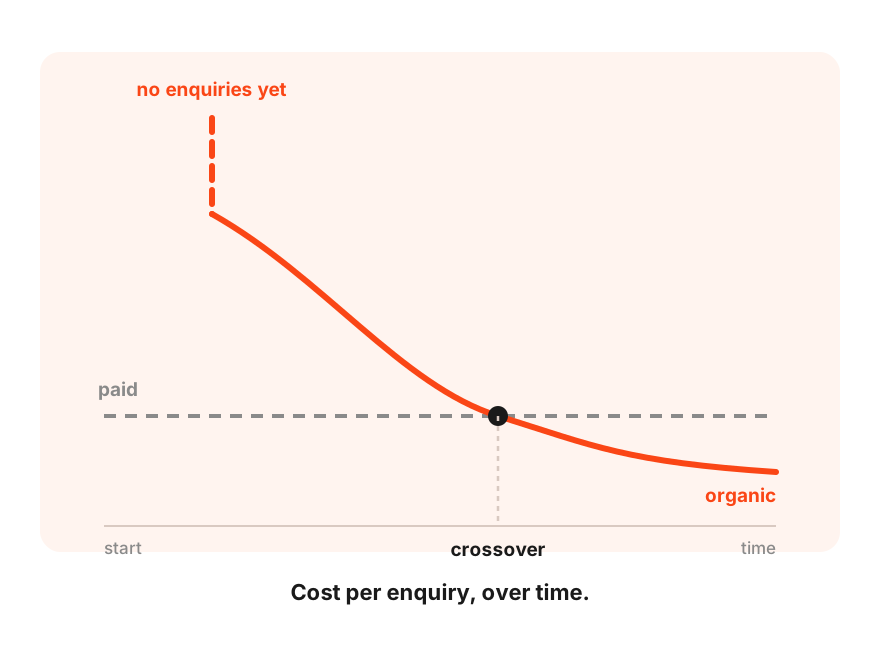
The first three months go on technical work and preparation, and there may be no visible movement at all in that period. Months four to six bring rankings movement and the first enquiries. Months six to twelve are where the bulk accumulates, and where most projects cross the break-even line. Until that point the channel is funded from somewhere else, and that gets built into the plan in March rather than discovered in July.
Faster happens in two situations.
The first is a technically neglected site where fixes produce a sharp jump from a very low base, sometimes as early as month two. The second is a niche quiet enough that there is barely anyone to compete against. Slower also happens in two, and they are the opposite. A brand new domain with no history at all, or a niche where the top three places have been held for years by the same companies with budgets you have no intention of matching.
The important part starts after break-even, and it is the part nobody talks about. Costs stay roughly flat, because a retainer does not grow just because the site began producing, and no agency invoices you a success surcharge. Meanwhile the return keeps compounding, because pages written in year one still work in year three, and links earned in spring do not disappear in winter. Each following year buys more for the same money. This is why the third year in this channel looks nothing like the first, and why judging SEO on its first six months is like judging an orchard by its first spring, when all you can see is sticks and the bill for the saplings.
In the first year you pay for something that does not exist yet. In the second and third you collect something you have already paid for.
Where organic overtakes paid
It helps to look past the two channels and at two curves instead.
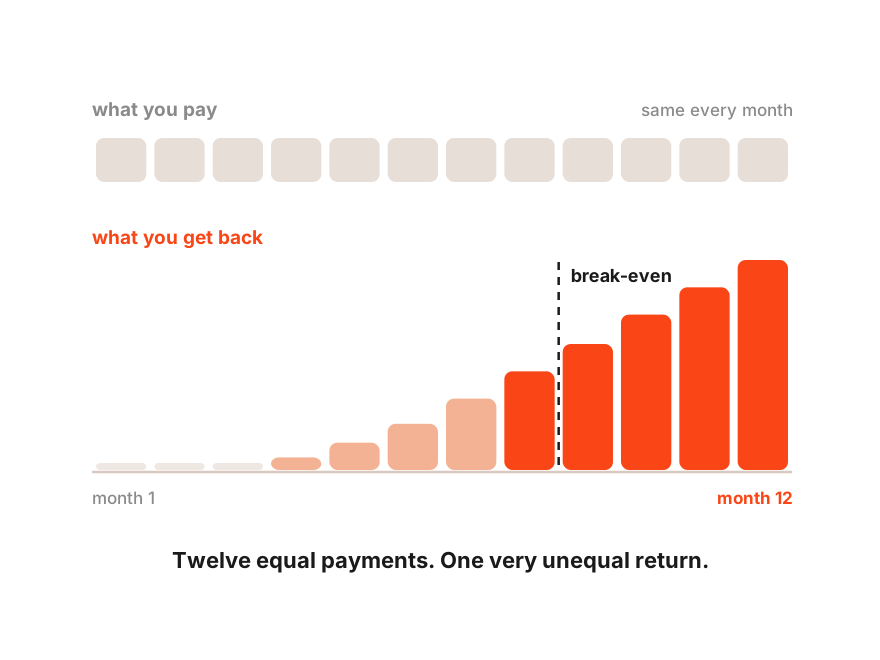
In paid search the cost per enquiry is roughly constant. You pay for every click, and however many months the campaign runs, the price of a lead stays in the same band. Switch the budget off on Friday and there are no enquiries on Monday.
Organic behaves differently.
In the early months the cost per enquiry is effectively infinite, because the spending exists and the enquiries do not. Then it drops sharply and at some point crosses the paid line. The whole google ads vs seo question comes down to where that crossing point sits. Its position depends on what a click costs in your category. For lawyers and insurers, where a single click costs about as much as lunch, organic overtakes paid somewhere around month eight. In categories with cheap clicks the crossing may never happen at all, and that is a legitimate answer rather than a defeat.
The seo adwords comparison has one more dimension that usually drops out of the conversation. Paid buys placement, organic buys trust, and a share of the audience deliberately scrolls past anything marked as an ad.
Paid gives you predictability today. Organic gives you independence from a budget tomorrow. The question is not which channel is better, but which of those two horizons you need more right now.
The asset that stays behind
A section that appears almost nowhere, even though it reframes the entire conversation.
Money spent on advertising disappears with the campaign. You bought impressions, the impressions ran out, next month you buy again. Money spent on organic settles into the site. The pages stay. The links stay. Positions hold on momentum long after the work has stopped.
The consequence is noticed rarely, and it is entirely material.
A company with a stable organic pipeline is worth more on the market than an identical company without one. The reason is simple. A buyer acquiring a business is buying a predictable flow of customers, not an ad account that has to be fed every month to stop the phone going silent. Picture two identical clinics with identical revenue, where one gets half its patients from organic and the other pays for every single one. The first will sell for noticeably more, and the same logic applies in a conversation with a bank about a credit line.
So the question of whether it is justified gets framed wrongly when SEO is counted purely as an expense. Half of that money is expense. The other half is an investment in something that stays yours.
Timing matters as much as the decision
The second thing almost nobody thinks about. You can make the right call and still lose on having made it at the wrong moment.
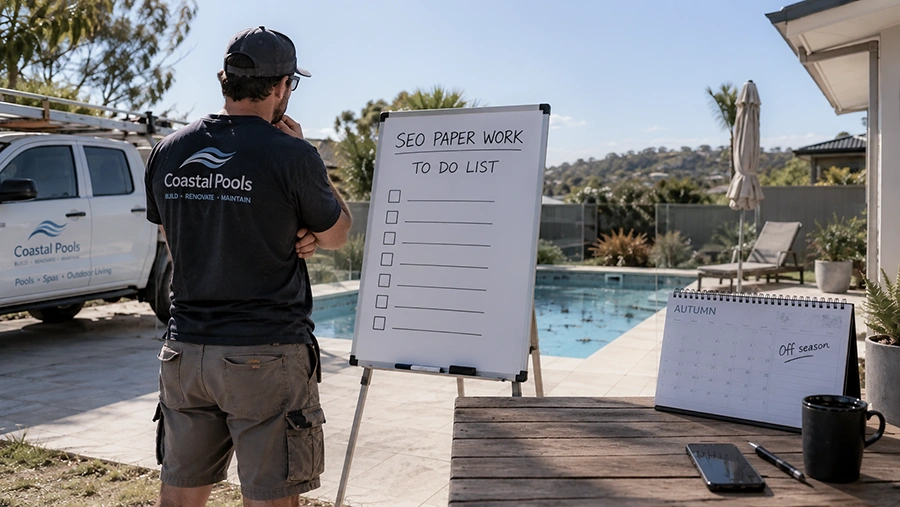
Australian business is heavily seasonal, and the seasons here are sharp. Pools, air conditioning, landscaping, tourism, the run-up to the holidays, all of it has a narrow window when the money actually moves. Now lay the SEO curve over that. The ramp takes six months and no amount of wanting will shorten it. If your peak is in December and you started in September, you physically cannot make it. You will pay for the ramp in full, see your first enquiries in January once demand has dropped, and then wait twelve months for the next window.
The money is not wasted in that case. The result simply arrived one season late.
The right start is six months before your peak, and nine is better. For a December season that means beginning in March, which is precisely when the phone is quiet, the till is quiet, and it feels like the last possible moment to be spending on marketing. That is the awkward part of it. The decision has to be made at the worst psychological moment for making it, rather than when the money feels available.
The worst time to start SEO is once the season has already begun. The best is a dull month when it feels like there is no spare money for it.
Who should not start
The most useful section in the article, and the one usually written last and shortest.
You cannot keep up with the work you already have. A pool builder booked out until next summer earns nothing from new enquiries. What they get instead is an obligation to turn people away and the risk of collecting bad reviews from the ones turned away. Fix the capacity first, then go looking for demand.
You need the money this quarter. If your cash flow will not survive six months, the question is not how effective the channel is, it is whether you will still be trading when the results arrive. Advertising is the answer here, and choosing it is a sound decision.
Demand for what you sell does not exist. The category is new, or the purchase is impulsive, or people simply do not put it into words in a search box. SEO does not create demand. It intercepts demand that is already there.
The problem is not traffic. People arrive and do not buy, and while conversion is broken, more visits only scale the losses.
A domain move or a rebrand is coming. Investing ahead of a migration means paying twice, because a portion of what accumulates will have to be rebuilt.
The market is too narrow. A handful of deals a year, buyers you could count in dozens, and one conversation at an industry trade show worth more than a year of organic traffic.
If you cannot serve the people already calling, what you need is a second crew, not more visibility. If people arrive and do not buy, what you need is a working page and a phone somebody answers.
Run it on your own numbers
The calculation takes ten minutes and settles the question more precisely than any article can.
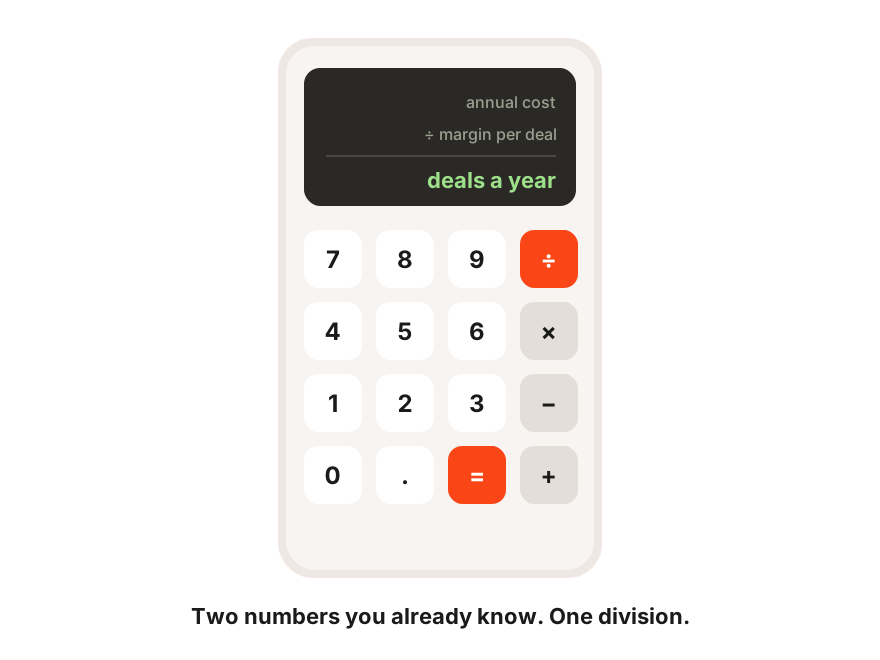
- Take the average margin on one deal. Not revenue, margin.
- Take the annual cost of SEO, meaning the monthly fee times twelve.
- Divide the second by the first. That is how many deals a year you need to break even.
- Divide that by twelve. That is your monthly bar.
- Check the bar against actual demand in your niche.
- Compare the result not against zero, but against the best alternative use of the same money.
That last point decides everything and is the one most often skipped. Without it the calculation answers whether SEO is profitable, instead of whether it is the best thing to do with that money.
Picture a workshop where the margin on a single job is close to a month of SEO. One deal a month covers it, and the decision makes itself. Now picture a shop with twenty dollars of margin per sale. Covering the same fee needs more than a hundred sales a month from organic alone, and the question shifts to whether that much demand exists in the category at all. The same money could go into advertising, a second crew, equipment, or into fixing the site’s conversion. The cost effectiveness of SEO is decided not by whether it turns a profit, but by whether it turns a better profit than the best alternative available to you.
If you are short of data about your own site at this stage, a website audit supplies most of the missing numbers in one go, with no monthly commitment attached.
SEO payback FAQ
How long before SEO pays for itself?
For most projects break-even falls in the second half of the first year. The first three months usually show no visible change, months four to six produce the first enquiries, and accumulation follows. Faster on neglected sites starting from a low base, slower on new domains in competitive niches.
Is SEO worth it for a small business?
It is, provided demand for your service exists in search, your site converts, and you have the capacity to serve new customers. If any one of those three is missing, the money will do more somewhere else.
Which is cheaper, ads or organic?
Ads, in the early months. After that the cost per enquiry in organic keeps falling while paid stays flat, and at some point the two cross. Where exactly depends on the click price in your category.
What happens if I stop?
Rankings do not vanish immediately, but they start to settle, because competitors keep working. What you built gives you a few months of momentum, after which the gap reopens.
When is the best time to begin?
Six months before your seasonal peak, and nine is better. Starting mid-season almost guarantees that you pay for the ramp and miss the chance to use it until the following year.
When the answer is yes after all
Go back to the list at the top. Every argument against it still holds, and none of them has gone anywhere.
But they describe the risks of the channel rather than its futility, and each one has an answer. The risk of a long start is managed by a plan where the first six months are funded from elsewhere. The risk of algorithm dependence is managed by not building your whole economy on one channel. The risk of a competitor’s head start is managed by choosing the queries where that head start does not apply, meaning the narrow and local ones rather than the broad ones.
The answer is yes when demand exists, conversion works, capacity is there, the timing is right, and the arithmetic produces a number you can actually reach. If even one of those is missing, waiting and revisiting the question in six months is the better call.
At Advantrise we start with a free audit, after which we sometimes advise against starting now. We will show you whether demand exists in your niche, what is currently holding the site back, and how long the ramp would take before your season. It costs nothing. The decision after that is yours, and it may well turn out to be no.
Subscribe to our newsletter