
content
Three SEO packages had one thing in common, and for fourteen months nobody noticed it. Not the owner, not the two mates he showed the paperwork to over coffee, and not the agency that eventually won the money.
By the time it became obvious, the year’s budget was gone.
SEO cost Australia wide varies more than most buyers expect, and across those three proposals it varied more than threefold. That gap was the only thing anyone looked at. They were looking in the wrong place.
It started in March. The owner of a small furniture workshop decided the website should finally bring in orders rather than simply exist somewhere online. He did what everyone does in that situation and asked for three quotes, then laid them out side by side.
The first came in at twelve hundred dollars a month. The second at two thousand eight hundred. The third at seven and a half thousand.
He picked the middle one. The outer two looked suspicious from opposite directions, and the middle felt like a sensible compromise. Reasoning nobody can argue with, and reasoning that guarantees nothing.
Fourteen months later organic traffic had crept up a few per cent, a handful of rankings had improved, and not one of them had produced a customer. When he finally sat down to work out why, the thing all three proposals had in common became obvious.
Not one of them said how many hours of work sat behind the fee.
All three listed the same areas of work in the same words. Technical optimisation, content, link building, monthly reporting. Those words cost nothing to write and promise nothing, while the volume behind them can differ twentyfold. He had been comparing prices without any idea what he was comparing.
What follows covers where the number comes from, the three payment formats and what businesses of different sizes actually pay. Then what pushes the figure up and down, which line items hide underneath the monthly fee, why the cheapest option usually turns out to be the most expensive, and how to work out whether any of it pays back. At Advantrise we run SEO services for businesses of very different sizes and price this work every week.
What you are actually paying for
A monthly SEO fee is bought time, spread across several kinds of work.
Technical work, meaning speed, indexing, structure and errors in the code. Content, from service pages through to articles. External links and mentions, the most expensive part of the lot, because it comes down to negotiating with actual people. Google Business Profile work if the business is local. Analytics and reporting, without which nobody can see what the money bought.
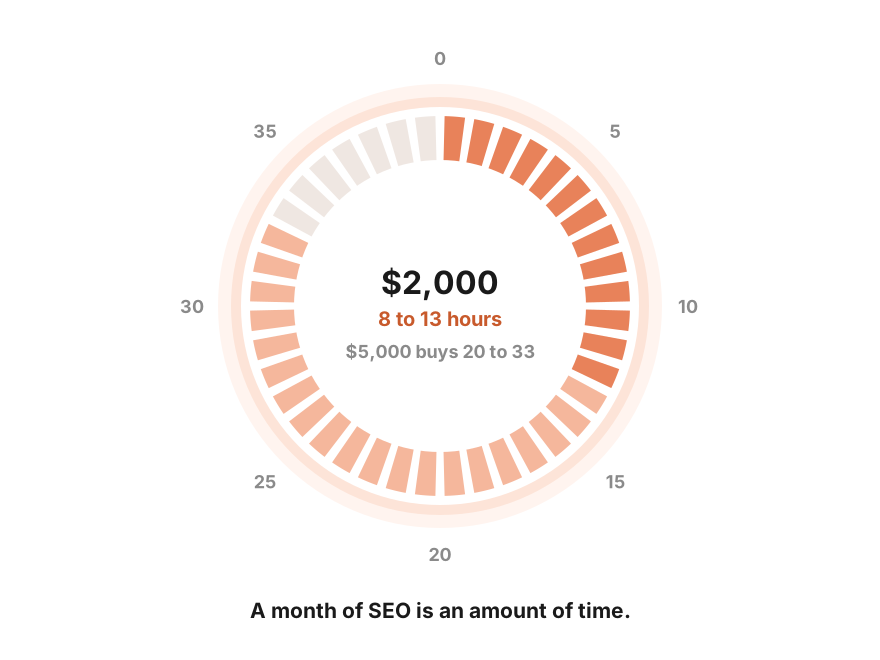
Hourly rates for SEO specialists in Australia are known and published, usually somewhere between one hundred and fifty and two hundred and fifty dollars. Divide a monthly fee by the rate and the volume behind it appears. Two thousand a month is roughly eight to thirteen hours. Five thousand is twenty to thirty-three.
SEO services pricing has one more layer that rarely gets explained. Some of the work happens once, some of it never stops. A technical audit, keyword research and analytics setup all belong at the start and are only refreshed afterwards. Content, links and reporting continue for as long as you keep paying. If keyword research is still sitting in a monthly deliverables list a year in, it is worth asking what exactly happens inside that line in month ten.
Retainer, project, hourly
Three payment formats, and each one has a situation it genuinely suits.
A retainer is a fixed monthly fee for an agreed volume of work. It is the default across the market, because search visibility accumulates and rewards continuity. This is also the format in which the SEO packages advertised on agency websites are sold. It fits when you need steady growth rather than a single task completed.
A retainer is an agreed number of working hours bought every month, rather than a price attached to a result. You are paying for capacity, the same way a business pays a bookkeeper, and the deliverables list describes how that capacity gets spent.
A project is a fixed price for work with a start and an end. The classic examples are a one-off audit, a site migration to a new domain, a rewrite of the service pages or an analytics setup. SEO audit pricing in Australia runs from roughly fifteen hundred to eight thousand dollars depending on the size of the site, and an SEO audit bought on its own is often the sensible first step for anyone not ready to commit monthly.
Hourly suits the case where your own team does the work and the agency supplies direction and review. The same one hundred and fifty to two hundred and fifty dollar range applies.
There is a fourth format, payment on results. It sounds appealing and almost never works as advertised. Tie it to rankings and it gets gamed with keywords nobody searches for. Tie it to sales and it requires access to your financials and a level of trust that does not exist at the start of a relationship.
What it costs by size of business
Prices in Australian dollars, and almost every agency quotes them excluding GST, so add ten per cent to each figure in your head.
A local business with one location. One thousand to fifteen hundred a month. Google Business Profile, technical basics, a few service pages, simple reporting. In a quiet suburb with light competition that is genuinely enough.
Small and medium businesses. Fifteen hundred to three thousand. The densest part of the market. Content, moderate link building and conversion work all get added here.
Competitive niches. Three thousand to five and a half. Legal, medical, real estate, finance. These need a proper strategy, active link work and several cities running at once.
National campaigns and large stores. Five and a half thousand to ten and above. A dedicated team, large keyword sets, migrations, thousands of pages to keep in order.
Pricing for SEO services published openly by Australian agencies starts somewhere between fourteen hundred and ninety and two and a half thousand a month. Below a thousand, published packages barely exist, and that absence says something on its own. Offers at three or five hundred dollars are out there, but they live in emails and phone calls rather than on a page listing deliverables.
What moves the number up and down
Four things change the figure more than anything else.
Competition in your niche. The main multiplier. Promoting a dental practice in inner Sydney and the same practice in a regional town differ by multiples rather than percentages, because in the first case you are up against businesses that have been investing in search for years.
The state of the site at the start. The most underestimated factor of the lot. A site built on a page builder five years ago eats the first two or three months of a retainer on technical repairs, and growth starts later. That is accumulated debt somebody has to clear, and it is better learned before signing than from the third monthly report.
Geography. Australian markets are not uniform. Isolated Perth, with wide default radiuses and competitors spread further apart, is one kind of job, and SEO in Perth prices differently from the same work in dense inner Sydney. Smaller and more price-sensitive markets behave differently again, which is why SEO in Adelaide often produces visible results on more modest spending.
How fast you want results. The only way to speed search up is to buy more work, which means paying more. It is the one lever that genuinely moves the timeline, and it is close to linear.
There is a fifth factor nobody advertises. Who actually does the work. Two agencies can quote the same number while one puts a specialist with ten years behind them on your account and the other sends the work offshore, leaving a local manager to forward the reports. Both models exist and both are legitimate, and they deliver very different outcomes for the same money. Asking who will physically work on the site, and how many other accounts that person carries, costs nothing and explains a great deal.
One more note on what the money is aimed at. Google SEO services pricing is effectively the whole conversation in this country, because every other search engine sits in low single digits of the market. An agency proposing a separate budget line for Bing or Yahoo either does not understand the market or is selling you air.
What hides under the monthly fee
The monthly payment is rarely everything you pay. Several line items live separately, and most people meet them on the first invoice.
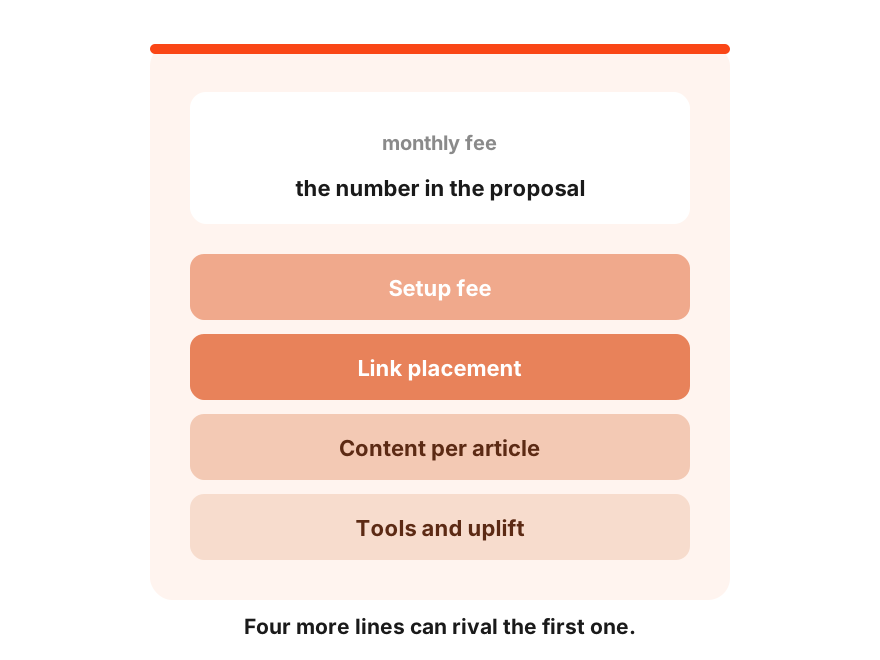
A setup or onboarding fee. A one-off charge covering the start, the audit and the configuration, anywhere from a few hundred to a few thousand. Sometimes entirely fair, because the first month really is heavier than the ones that follow. The only question is whether you were told about it before signing.
Tools billed separately. Rank tracking and link analysis software costs money, and some agencies pass it through on top of the fee. Including it in the retainer is the more common practice, since the agency needs those tools to do the work either way.
Link budget as a pass-through. The largest hidden item by far. The agency charges for the work while placement is paid separately, and that can double the invoice. Ask upfront whether placement sits inside the fee or on top of it.
Content charged per piece. A retainer can cover strategy while the writing itself is billed per article. It looks cheaper in the proposal and lands more expensive in practice.
An annual uplift. A clause raising the fee once a year sits in plenty of contracts and almost never comes up during negotiation.
A minimum term. Not money directly, but commitment. Six or twelve months with no exit means you pay for the whole period regardless of how the work goes.
None of these makes an agency a bad one. What makes it a bad sign is finding out after you have signed.
Why cheap SEO ends up costing more
Back to the arithmetic of hours, because it settles this question completely.
A five hundred dollar package is two or three hours of work. In that time somebody can produce an automated report and a handful of small edits. Delivering an audit, four articles, ten links and monthly reporting is physically impossible, because that list is roughly forty hours of work.
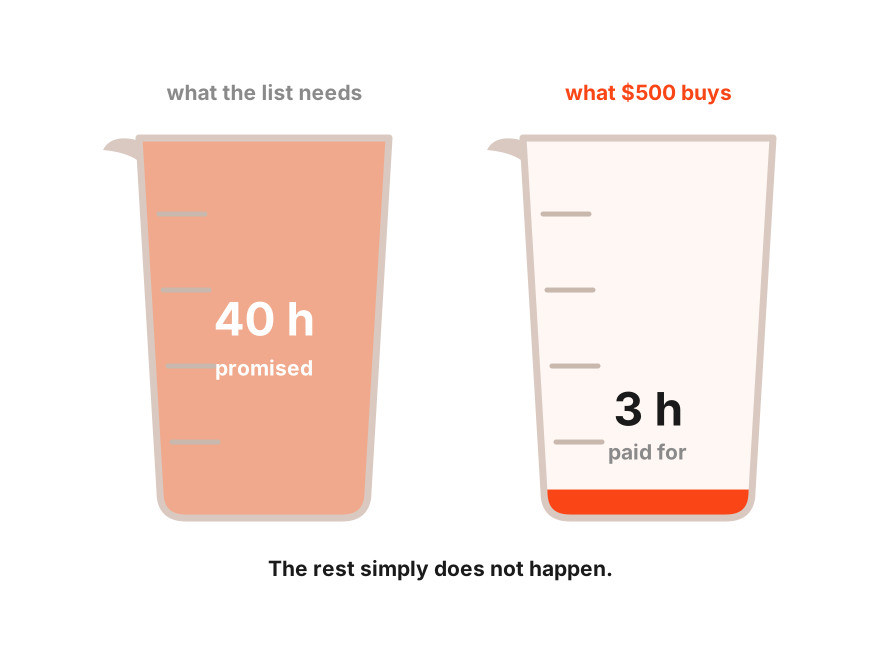
So something on the list will not happen, and it is usually the expensive part. Directories arrive instead of links, templates instead of content, and a rankings dashboard instead of analysis.
The real cost of cheap SEO is not the wasted budget though. It sits in three other places.
First, the lost year. A competitor on a working package moved ahead in that time and now costs twice as much to catch. Search compensates for lost time worse than any other channel, because rankings are not bought. They accumulate.
Second, the risk of a penalty. Cheap links are almost always bought links from networks, and the site pays for those, not the agency. Recovering from a manual action costs more than a year of doing the work properly.
Third, the cost of undoing it. Hundreds of templated suburb pages generated for volume have to be pulled down, rewritten from scratch and then redirected properly. That is a separate project, and you pay for it twice.
How to work out whether it pays back
Work backwards from a customer, not forwards from a price.
The sequence is simple enough. Take your average deal value and your margin. Work out how many deals a month it takes to cover the SEO fee. Then take your enquiry-to-customer conversion rate and you have the number of enquiries search needs to deliver. That is your target, and everything afterwards gets measured against it.
The logic without specific numbers. If one deal earns you roughly what a month of work costs, a single deal a month makes it worthwhile. If the answer comes out at twenty deals, the question is no longer the price of SEO but whether that much demand exists in your niche at all.
Allow six to twelve months. Technical fixes sometimes land sooner, but organic growth accumulates gradually, and anyone promising otherwise is either selling keywords with no demand behind them or promising nothing at all.
Measure qualified enquiries rather than rankings. A ranking is an intermediate signal that looks pleasant in a report and cannot be banked. Calls, form submissions and closed deals from organic traffic are what actually answer the question.
And one comparison worth running regularly. Work out your cost per customer from organic and from paid. In the early months organic will lose, because the spending has happened and the results have not accumulated yet. From roughly the second half of the first year the picture usually inverts, because organic enquiries do not charge you again each time.
SEO cost Australia FAQ
How much is SEO for a small business here?
A working range is one thousand to three thousand dollars a month, depending on competition in your niche and the state of your site. A single-location local business in a quiet suburb can sit at the bottom of that range, while a company in a crowded niche starts nearer the top.
Can I pay once rather than monthly?
Yes, for work with an end date. Audits, migrations, a one-off page rewrite or an analytics setup all sell as projects. Continuous ranking growth cannot be bought once, because your competitors are working every month.
Why will agencies not quote immediately?
Because the figure depends on the state of your site and the competition around it, and neither can be judged blind. The sound practice is to look at the site first and name a number second. A price quoted before anyone has opened your website is a rate card, not an estimate.
What does the monthly fee include?
Technical work, content and external links. Profile work for local businesses, plus analytics and the reporting on top of it. The proportions shift depending on what your particular project is missing.
What does an audit cost on its own?
Roughly fifteen hundred to eight thousand dollars depending on the size of the site. For anyone not ready to commit monthly, it is the cheapest way to find out what is actually holding the site back.
Back to the three proposals
The mistake was never picking the middle one. The mistake was comparing three numbers that carried no unit of measurement, in a document where every agency had written the same words.
The question that changes all of it sounds dull and costs nothing to ask. How many hours a month sit behind this fee, and who is going to work them.
At Advantrise we start with a free audit covering the state of the site, who you are actually up against and a realistic budget for the job in front of you. No obligation, and you decide from there.
Subscribe to our newsletter