
content
The bakery on the corner opens at six. By seven the queue is out the door and along the window, and the people standing in it are looking at their phones, because the wait runs about ten minutes.
Two hundred metres away, at the bus stop, someone opens maps and types “bakery near me”.
The bakery is not in the results.
Local SEO Australia is the work that closes exactly that gap, and this bakery has never done a minute of it. Eleven years on the corner, regulars every morning, the best coffee in three blocks. Its website, built years ago by the owner’s nephew, even ranks respectably for the bakery’s own name. Which is to say, for the people who already know it exists.
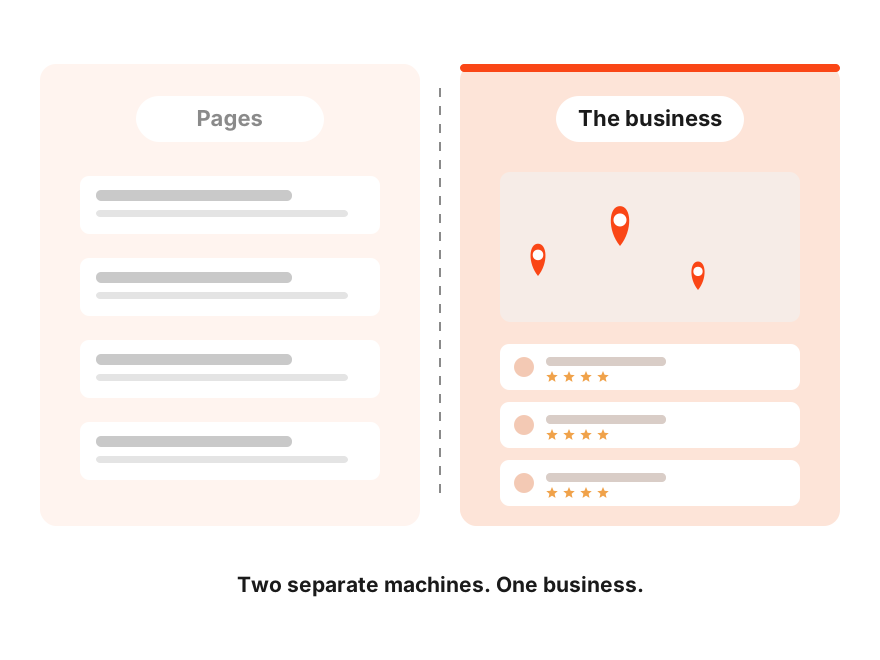
None of that is a Google glitch. Maps and organic results are two separate machines running on two separate sets of rules. A business can sit first in search and not exist on the map. It can own the map and have no website at all.
Everything worth knowing is below: how local search differs from the ordinary kind, how to set up a Google Business Profile step by step, and which Australian directories still function. Then reviews, local content, and why Perth needs entirely different work from Canberra.
At Advantrise we run local SEO services for businesses that earn from the streets around them. Start with the distinction that makes the rest make sense.
Two indexes, not one
Ordinary SEO ranks pages. Local SEO ranks the business itself.
The difference is not cosmetic. When Google decides which page to show for “how to fix a leaking tap”, it weighs text, links and what people do on the page. When it decides who to show on the map for “plumber near me”, pages barely enter the calculation. What counts there is the business profile, its reviews, mentions of it elsewhere, and the physical distance to whoever is searching.
The local pack is the block of three businesses and a map above the organic results. It draws on Google Business Profile data rather than website pages, which is exactly why a business can be invisible there while holding decent positions in ordinary search.
The practical conclusion follows on its own. Website work and map visibility are two projects that only partly overlap. The site supports local visibility, confirms what you do, and wins searches shaped as “service plus suburb”. It does not get you onto the map by itself.
One more distinction decides half your settings. Some businesses have an address customers walk into. Others travel to the customer. A cafe, a clinic, a salon and a law firm show an address and compete on proximity to whoever is standing nearby. A plumber or a window fitter hides the address and lists service areas instead. Profile rules, the job photos do, and even the logic of choosing a category differ between the two, and mixing them up is expensive.
Australians do not search by city
An Australian quirk that anyone trained on American material underestimates.
People here search by suburb, not by city. Not “dentist Melbourne” but “dentist Brunswick”. Not “cafe Sydney” but “cafe Newtown”. The city name turns up mainly when someone is visiting or planning ahead.
For pages that changes how you write titles and copy. A page built around a capital city competes with the entire capital and loses. The same page built around the handful of suburbs where you actually work wins searches with real intent and thinner competition. Local keywords in this country are suburb keywords first.
For the profile it means something else. Suburb names do not belong in the business name itself, that breaks Google’s guidelines. They belong in the description, in posts, in what customers write in reviews, and in the pages the profile links to.
Seven fields that decide visibility
The order below is deliberate, because each step leans on the one before it.
Business type and address. If customers come to you, the address shows and has to match what is on the door. If you go to them, the address is hidden and service areas take its place.
Primary category. The strongest lever anywhere inside the profile. Take the narrowest category that still describes your work accurately. A coffee shop that picked Restaurant instead loses its main query to neighbours with worse coffee.
Additional categories. For everything else you do, without going overboard. Ten categories dilute relevance rather than widening it.
Services and products. Filled in completely, with descriptions. This is the part of the profile Google matches against the wording of a query.
Hours, public holidays included. In a country with this many public holidays falling on different dates by state, that is not a detail. A profile showing open on a day you are shut collects bad reviews you did nothing to earn.
Photos. Real, recent, from your premises. For a business with an address they double as a landmark, since someone has to recognise the entrance when they arrive.
The questions section. Leave it empty and it fills up without you, not always accurately. Better to ask a few obvious questions yourself and answer them.
Worth separating what moves rankings from what moves clicks. Categories, services and reviews move rankings. Photos, posts and the description move the decision of someone who has already seen you. Both matter, and confusing them wastes hours.
Directories that are only a name now
This is where a widely repeated piece of advice has to go, and it goes with evidence.
Australia is not built like the United States. There, a layer of data aggregators pushes business details out across the ecosystem, which is why American guides tell you to start with them. We have no such layer. Our market historically ran through Sensis, bought by Thryv in 2021, so Yellow Pages, White Pages and TrueLocal now sit under one owner.
Their condition varies.
Yellow Pages is alive and still ranks for plenty of “service plus suburb” combinations. Free listings are available, so a correct basic profile there is worth having.
TrueLocal technically still runs, though what remains is a shadow of the directory it once was. Free listing requests route through the same Yellow Pages system, and practitioners long ago filed it under claim once and forget. We mention it because it still appears in almost every listicle search throws up, and people spend real time on it expecting an effect that will not arrive.
Localsearch has held up better than most, particularly across regional Queensland and New South Wales.
A citation is any mention of your business name, address and phone number on a third-party site. Directories, social profiles and even a mention in a local news story all count. Their job is not to lift rankings but to confirm to Google that the business is real and that its details agree everywhere.
The practical version of this saves money. Listing on two hundred directories does close to nothing. Inconsistency costs. An old address on one site, an old number on another and a shortened name on a third create the kind of confusion an algorithm reads as uncertainty. NAP consistency is the whole game here.
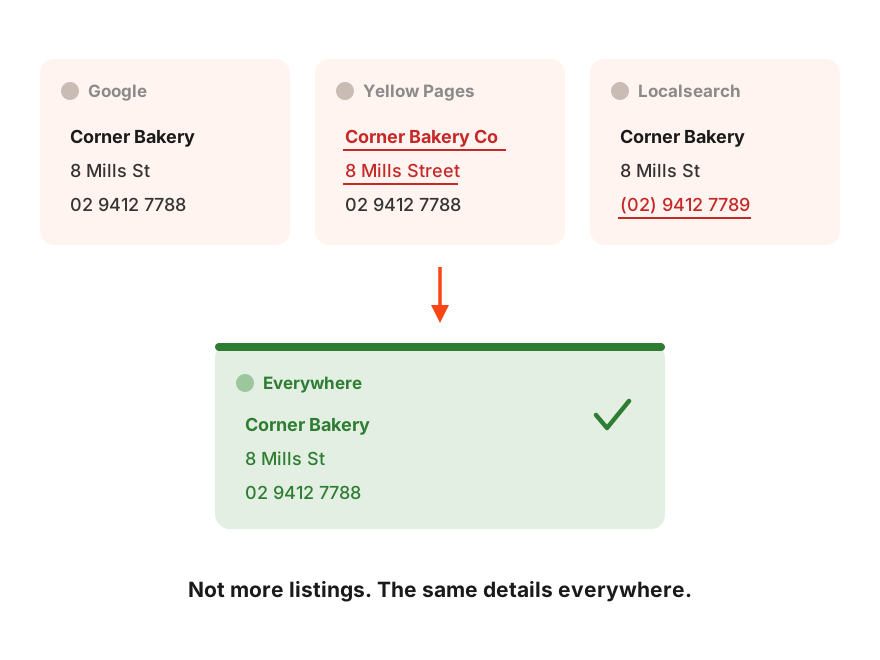
So directory work is not accumulation, it is cleanup. Build a list of everywhere you appear, check the details down to the comma, fix what disagrees. Once, thoroughly, then maintain.
Review velocity beats review count
Reviews sit inside the third local ranking factor, the one covering prominence.
The number everybody watches is the wrong one. A steady flow across a quarter outperforms thirty reviews in a week and silence afterwards. A sudden spike also looks like exactly what it is.
Reply to all of them, negative included, because the reply gets read by the next customer rather than the one who wrote it. Silence under criticism costs more than the criticism.
One trap catches even careful businesses. Asking for reviews is fine. Filtering for happy customers is not. The setup where you ask how it went first and only send the pleased ones to Google breaks Google’s guidelines and gets penalised. Ask everyone the same way.
For a business with an address, industry platforms sit alongside Google. Clinics live in medical directories, restaurants in dining ones, lawyers in legal ones. Those profiles are citations too, so the details have to match everywhere else.
The thin ice of location pages
Location pages are the fastest way either to win organic results or to bury the site under thin content.
The difference is what is in them. A page where only the suburb name changes and the rest is copied is a template, and Google knows the pattern. A page naming actual landmarks, local quirks, jobs finished in that area and the questions people there actually ask is a piece of content in its own right.
A simple test. If you cannot write anything about a suburb beyond its name, it does not need a page.
LocalBusiness schema is structured data in the page code that tells search engines your name, address, phone, hours and business type outright. It does not lift rankings on its own. It removes ambiguity in how a machine reads your details.
That matters more now that your details feed not only search engines but the answers language models generate. The fewer contradictions between site, profile and directories, the smaller the chance of being described inaccurately.
Two maps everyone forgot
A channel almost nobody works on, which is exactly why there is room in it.
iPhone share in Australia is high, and iPhone owners open Apple Maps by default rather than Google. A profile there is free through Apple Business Connect. One detail specific to our market is worth knowing. Apple Maps in Australia leans partly on Telstra and Thryv data plus Yelp, the same sources you were tidying in the directory section.
Bing Places sends less direct traffic, but its data feeds Copilot answers. For a business that wants to turn up in assistant answers rather than only in classic results, it is a cheap step.
Both profiles are set up once and need little beyond an hours update. Against the ongoing work Google demands, that is a few hours in total.
What local SEO packages actually cover
Everything above is a local SEO checklist you can work through yourself. Profile, directories, reviews, suburb pages and the two extra maps add up to a couple of weekends, and none of it requires a supplier.
The question arrives later. When it turns out nobody has time to maintain it every month, or when the business down the street is doing the same work but systematically and faster. That is when an owner goes looking at what agencies sell, finds the same list of words in every proposal, and has no way to tell them apart.
Local SEO packages differ from ordinary ones in composition rather than size.
An ordinary package puts its weight on technical work, content and external links. A local one spends most of its hours on the Google Business Profile, tidying citations, running reviews and building suburb pages. Technical work and content do not disappear, they become support rather than the core.
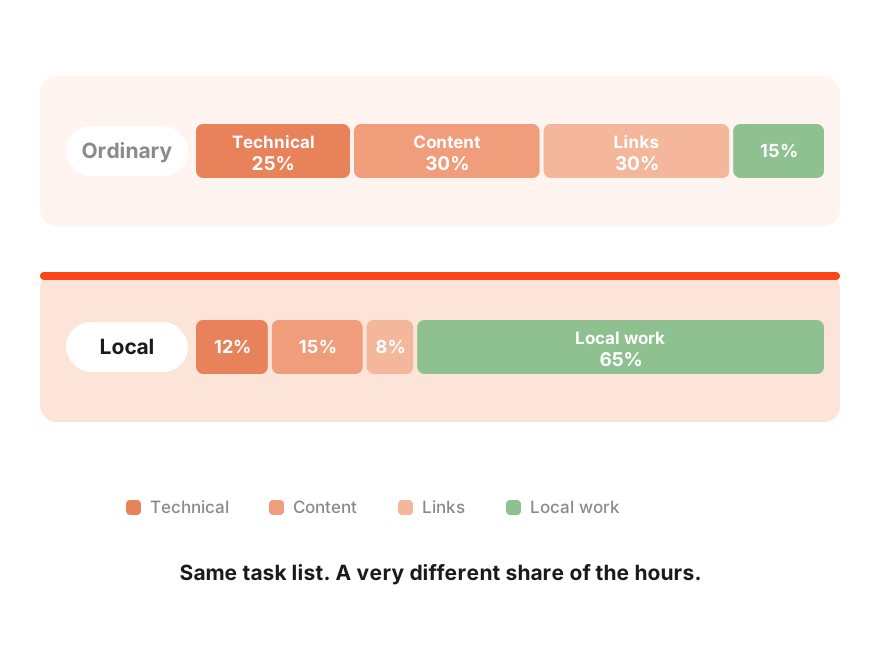 Small businesses usually buy the local version, and order matters more than volume. Profile and details first, the cheapest work with the fastest return. Reviews second, because they accumulate slowly and starting late costs months. Suburb pages and links come third. SEO services for small business live or die on that sequence, not on the length of the deliverables list.
A package for one location and a package for a chain of five differ in kind. Every location is its own profile, its own reviews and its own page, so local SEO for small business with a single shopfront is a different product from a multi-site retainer.
Four questions for a local SEO company
There is no short answer to this one. There are four questions that clear the picture quickly.
What exactly happens in month one? A list of tasks, not directions. “Fix the category, reconcile details across seven directories, set up review collection” is an answer.
Who owns the profile and the accounts? The Google Business Profile, the analytics and the access stay yours whatever happens to the relationship.
How will results be measured? Map positions for specific queries from specific points in the city, calls and direction requests from the profile. Total site traffic is a secondary number for a local business.
What is the approach to reviews? If the answer involves screening customers before sending them to Google, there is no need to hear the rest.
The warning signs are recognisable too. A guaranteed first place on the map, a promise to list you on two hundred directories, work that runs without access to your own analytics, and a price quoted before anyone has looked at your profile. A local SEO company worth hiring wants to see the profile first.
Some of this you can close yourself, and on a quiet market that is enough. Filling in the profile, reconciling details, setting up review collection and writing a few suburb pages is a couple of weekends. It gets harder with several locations, dense competition, or a competitor who has been investing in search for years.
Every city plays by its own rules
The Australian local market is not uniform, and what works in one capital produces nothing in another. Businesses shopping for SEO services NSW wide face the tightest competition in the country, while the same work in smaller markets pays back faster and cheaper.
Perth
The most isolated large city in the country, and the data shows it. Competitors sit further apart, so each profile holds a wider default radius than anything on the dense east coast. Local demand here is the largest outside the eastern capitals, and mining creates a layer of B2B queries that exists nowhere else. SEO in Perth is built from the profile and the suburbs outward, not from fighting over city-wide terms.
Gold Coast
A market with pronounced seasonality. Tourist flow reshapes the query mix several times a year, and what brings calls in December goes quiet in July. Gold Coast SEO needs content planned around the season and unusually careful attention to hours and profile accuracy, because part of the audience is always visiting and deciding on the spot.
Canberra
A government town, and that changes everything. Longer decision cycles, more B2B, fewer impulse searches. The local pack still works, but reputation and the website decide more often than proximity does. SEO in Canberra sits closer to classic B2B work with a local layer on top.
Adelaide
A smaller market and a more price-sensitive one. Customers compare longer and more carefully, and competition is lighter than in Sydney or Melbourne. It is a good market to enter organically without a large budget. Adelaide SEO services show results on modest spending, particularly around wine, defence and the services feeding both.
Sunshine Coast
The fastest-growing population among the regions we watch. That means a constant arrival of people looking for everything from scratch, from a dentist to an electrician, with no local recommendations to fall back on. Sunshine Coast SEO wins on the fact that a large share of residents find services in search rather than through neighbours.
Darwin
The smallest and most remote market of the lot. Competition is minimal and query volumes are modest, but reaching the local pack is realistic within a few months of tidy work. Local SEO Darwin is the case where a properly configured profile and a dozen reviews deliver what would take a year of fighting in Sydney.
Local SEO Australia FAQ
How long until results show?
A Google Business Profile can shift within weeks if it was half-filled and then sorted out. Organic positions for local queries accumulate more slowly, three to six months in quiet niches and up to a year in dense ones.
Do I need a website if I have a Google profile?
The profile wins the map. The website wins everything else. Without one you will not appear for “service plus suburb” searches, you cannot show your work, and the profile itself ranks worse with no page to confirm what you do.
How many directories do I need?
Not many. A few live Australian ones and a few industry ones, with details that match exactly. Volume does nothing. Agreement does the work.
Can I do local SEO myself?
The base of it, yes. Profile, details, reviews and a few suburb pages are within reach. It gets harder with site technicals, structure across dozens of service and suburb combinations, and analytics that shows which queries actually produce calls.
What if a competitor is buying reviews?
Report them through the profile interface and keep building your own steady flow. Google clears out fake reviews periodically, and businesses that stayed inside the rules only gain from those sweeps.
Back to the bakery
To exist for the person at the bus stop, that bakery needs no new website and no budget. It needs the right category in its profile, matching details across a few directories, a habit of collecting reviews, and one page that properly describes where it is and what it serves.
Local SEO is rarely about scale. It is about care with details that look small on their own and together decide whether you exist two hundred metres from your own front door.
At Advantrise we start with a free audit showing which queries put you on the map today, which parts of the city cannot see you at all, and how much of that you could close without us. No obligation, and you decide from there.
Subscribe to our newsletter